I. Core Structure and Materials Science
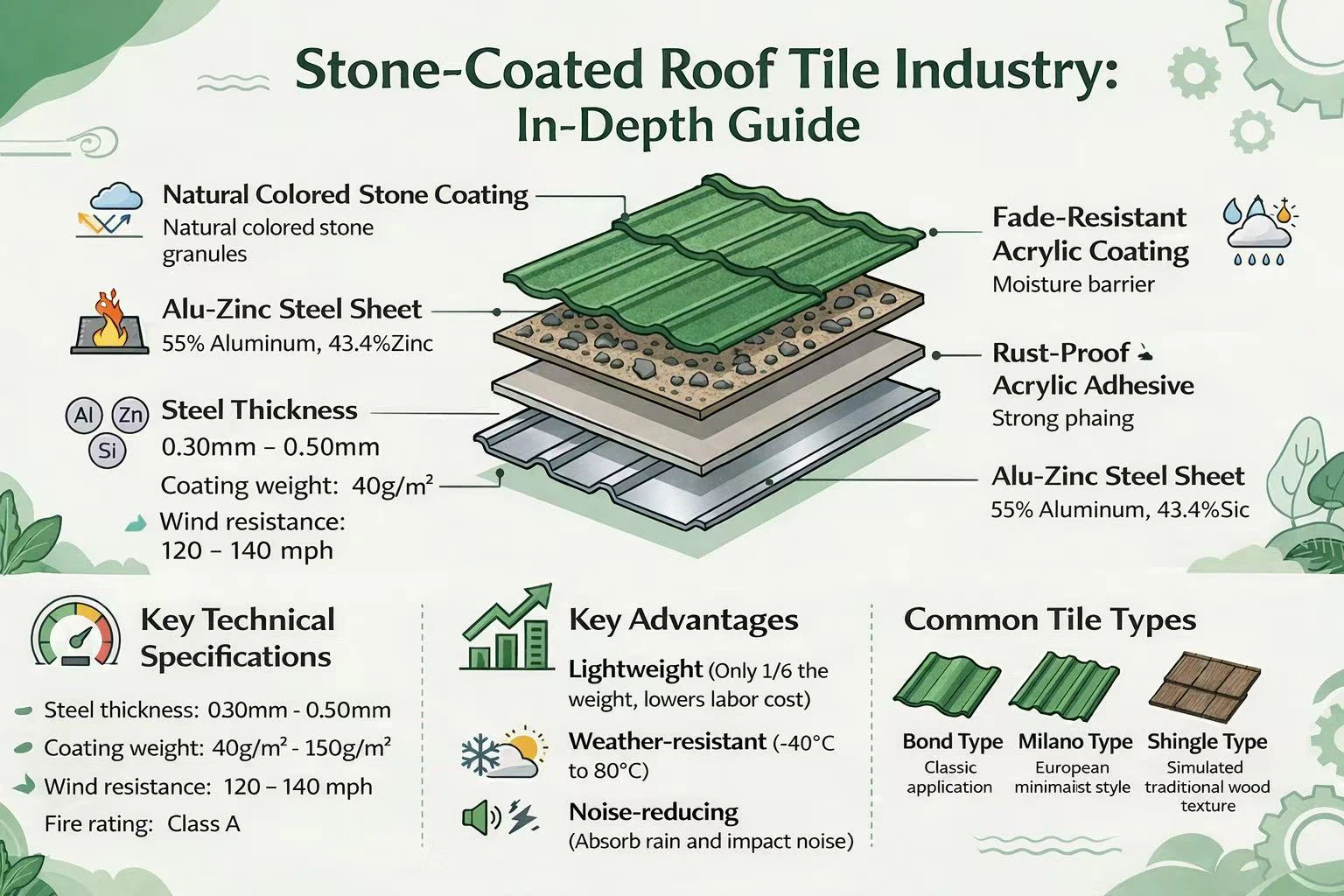
The colored stone tiles are not a single material but a composite structure, and their durability stems from the synergistic effect of multiple layers of protection:
1. Base Material: Galvalume Steel (Aluminum-coated Galvanized Steel)
• Composition: Typically consists of 55% aluminum, 43.4% zinc, and 1.6% silicon.
• Advantage: Its corrosion resistance is 3-6 times that of ordinary galvanized steel. Aluminum provides a physical barrier, and zinc offers sacrificial anode protection.
2. Surface Particles: Sintered Stone Chips
• Source: Natural basalt particles.
• Process: Fired and sintered at temperatures above 1200°C.
• Function: Resists ultraviolet rays, reduces noise (absorbs the sound of rain impact), enhances appearance, and does not fade.
3. Adhesive: Acrylic Resin
• Function: Bonds the colored stones at the bottom layer, and the top layer (Overglaze) provides a protective film to prevent water penetration and the growth of weeds and mold.
II. Production Process Flow
1. Automatic Punching and Forming: The galvanized steel plate is pressed into specific shapes (such as arc-shaped, wood-grain-shaped, Roman-shaped) using precise molds.
2. Automatic Spraying of Base Coat: High-performance acrylic primer is evenly applied.
3. Automatic Sanding: Ensure that the colored sand is evenly distributed without any exposed base.
4. High-Temperature Drying: The product is cured in a constant-temperature tunnel kiln to integrate the colored sand with the steel plate.
5. Topcoat Spraying and Secondary Drying: Enhance the surface gloss and protection.

The 5 core competitive advantages (selling points) of colored stone tiles:
• 1. Extremely high cost-effectiveness and long lifespan:
Although the initial purchase cost is slightly higher than that of asphalt tiles, their lifespan is up to 30-50 years, and there is almost no maintenance required in the later stage, with the annual cost being extremely low after averaging.
• 2. Convenient construction (cost savings):
Due to their light weight and large area (about 0.5 square meters per tile), the installation speed is three times faster than traditional tiles, and the strength requirements for the roof support structure are extremely low.
• 3. Extreme climate adaptability:
• Cold-resistant and heat-resistant: No cracks or deformations occur in temperatures ranging from -40°C to 80°C.
• Earthquake-resistant: The interlocking installation method ensures that it will not slip and cause casualties in earthquakes like ceramic tiles.
• 4. Sound insulation and heat insulation:
The colored sand layer can effectively break the kinetic energy of raindrops and eliminate the "drumming effect" of metal roofs; the reflective layer can significantly reduce the heat absorption of the roof in summer.
• 5. Renovation advantage (Roof-over):
In many countries, colored stone tiles can be directly installed on old asphalt tiles or wooden tiles without the need to dismantle the old roof, saving the high cost of waste disposal.